I am nowhere man. If you are here you are indeed nowhere. The music in this collection has nothing in common, other than the fact it comes right out of nowhere.
Wallingford Riegger was a consummate craftsman, deploying every note with precision and care. Music for Brass Choir, although completed later in his career (1949), exhibits the vitality that was his trademark:
.
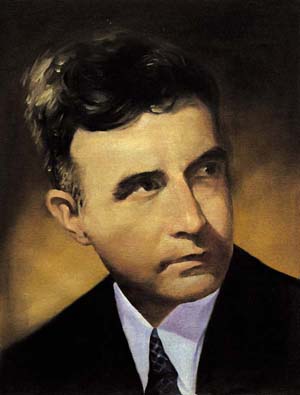
Wallingford Constantin Riegger was
a fascinating and prickly figure in the history of American music.
Although Riegger has been unfairly marginalized, works like his Music for Brass Choir, Study in Sonority, and Dichotomy
remain powerful and uncompromising pieces. Making use of serial
techniques before it later was the vogue in academia, Riegger's
twelve-tone compositions were quintessentially American in their
aggressiveness and rhythmic drive...a far different sound than the dry
atomistic serialism of
the fifties and sixties. It was Riegger's misfortune to have composed
in a style that doesn't appeal to today's musical tastemakers.
He
was born in Albany, Georgia in 1885. He learned the violin and the
cello as a child and in 1904 went up to Cornell University but the
following year transferred to the Institute of Music and Art, later
known as the Juillard School. Between 1907 and 1910 he was in Munich and
Berlin continuing his studies. He made his conducting debut with the
Blüthner Symphony Orchestra in 1910. On his return to America he earned
his living as a cellist in the St Pauls Symphony Orchestra in Minnesota.
Surprising he returned to Germany from 1913-17 when the Great War was
in progress. Here he conducted several opera and symphony concerts.
The
circumstances of Riegger's death were as unusual as his life and music.
While walking on a New York street one day in 1961, he became entangled
in the leads of several dogs who had escaped from their master. The
resulting fall resulted in brain injury and death soon after.
I shine bright and shed light from afar 93 million miles to be explicit (8 light minutes if you're planning a visit) See I'm the big daddy and this is his system My turn to burn so keep on listening I give light when all around is dark Your choice get sparked or mark my remarks
Sea ice couldn't hold me back I fall through forty feet in one minute flat Meet a solar controller, 'cause that what I was meant to be 'Cause I was a mystery
Decade is null Decade is null! (It's hot, it's hot, it's very hot)
I'm burning up now!
(It's bright, it's bright, it's very bright)
I'm burning up now!
Decade is null, decade is null, decade is null Check it out while I burn your skull
I'm burning up now!
Decade is null Hold and praise your nearest superstar I shine bright and shed light from afar 93 million miles to be explicit (8 light minutes if you're planning a visit) See I'm the big daddy and this is his system My turn to burn so keep on listening I give light when all around is dark Your choice get sparked or mark my remarks
Decade is null, decade is null, decade is null Check it out while I burn your skull
I'm burning up now!
Decade is null, decade is null
From one to all, hear this poem and Try to understand the greatest power known to man Am I a nuclear bomb, I'm that I make you look like a firecracker Alpha and Omega, beginning and end How can you claim I ain't God, my friend My atomic magnitude is explosive I could keep a planet in motion or roast it!
Decade is null, decade is null, decade is null Check it out while I burn your skull
Into the sun!
I emit energy, over all wavelengths From x-rays to radio waves Being the most dominant body of the Solar System I am the Earth Star
I'm burning up now! Hold and praise your nearest superstar
I shine bright and shed light from afar 93 million miles to be explicit (8 light minutes if you're planning a visit)
I'm burning up now!
See I'm the big daddy and this is his system My turn to burn so keep on listening
I'm burning up now!
I give light when all around is dark Your choice get sparked or mark my remarks Sea ice couldn't hold me back I fall through forty feet in one minute flat Meet a solar controller, 'cause that what I was meant to be
I'm burning up now!
'Cause I was a mystery
Chain of carbon and nitrogen Witness the power of chains Everything dies in fiery heat Everything dies in fiery heat
I'm burning up now!
Everything dies in fiery heat Everything dies in fiery heat...of the sun
I emit energy, over all wavelengths From x-rays to radio waves Being the most dominant body of the Solar System
Ballet Mécanique was originally written to accompany a Dadaist film of the same name, directed by Dudley Murphy and Fernand Léger, with cinematography by Man Ray. Originally scored for 16 player pianos and a large percussion battery, Anthiel found it impossible to properly synchronize the player pianos in a live performance - so he substituted four human pianists at the premiere. Thanks to modern technology this all-robotic version of George Antheil's infamous Dada provocation can now be heard in its original conception. Features new robotic instruments from LEMUR: League of Electronic Musical Urban Robots (http://lemurbots.org)
At various times in his checkered life, Partch was a hobo, and "The Wayward" is a chronicle of those experiences. Partch's titles and subtitles tell his tale, from "Barstow: Eight Hitchhiker Inscriptions from a Highway Railing at Barstow, California" to "San Francisco: A Setting of the Cries of Newsboys on a Foggy Night in the Twenties" to "The Letter: A Depression Message From a Hobo Friend" to "U.S. Highball: A Musical Account of a Transcontinental Hobo Trip."
Barstow: Eight Hitchhiker Inscriptions from a Highway Railing at Barstow, California:
Here the music transcends the almost pointillistic daubs of the "Intrusions" and becomes a dense, flowing symphony of twanging, plunking, tapping, purling microtonal moans and sighs. The sheer junkiness of the sounds, their homemade, crazy-true authority, seems a proper analogue of hobo life. Partch's musical constructions are like Simon Rodia's Watts Towers in Los Angeles, funky, obsessive and grand..."
The words of Barstow are funny, profane, touching, and cynical - like Partch's music itself (in this performance the spoken words are performed by the composer)
Number One
[spoken] It's January twenty-six. I'm freezing. Ed Fitzgerald, Age nineteen. five feet ten inches, black hair, brown eyes. Going home to Boston Massachusetts, It's four p.m., and I'm hungry and broke. I wish I was dead. But today I am a man.
[sung] Going home to Boston, yuh-huh, Massachusetts. It's four p.m., and I'm hungry and broke. I wish I was dead. But today I am a man -- Oh-- O, I'm going home-- to Boston, yuh-huh, Massachusetts.
Number Two
[spoken] Gentlemen: Go to five-thirty East Lemon Avenue, Monrovia, California, for an easy handout.
[sung] Go to five-thirty East Lemon Avenue, in Monrovia for an easy handout, gentlemen. Yo-ho-ho -- Yoo-hoo-hooo -- Ya-ha-ha-- Yee-hee-hee-- Go to five-thirty East Lemon Avenue, in Monrovia for an easy handout, gentlemen. Yo-ho-ho -- Yoo-hoo-hooo -- Ya-ha-ha -- Yee-hee-hee
Number Three
[spoken] Marie Blackwell. Age nineteen. Brown eyes, brown hair, considered pretty. One-eighteen East Ventura Street, Las Vegas, Nevada. Object: matrimony.
[sung] Age nineteen, Brown eyes, brown hair, Oh, but I'm considered pretty. Here's where I live-Dah dah dah dah -- One-eighteen East Ventura Street, Las Vegas, Nevada. Taa -- Ta-ta-ta ta-ta-ta-ta-ta -- ta-ta-ta -- ta-ta-taa- My object is - Yoo-hoo-hoo - Matrimony!
Number Four
[intoned] Dear Marie, a very good idea you have there. I too am on the lookout for a suitable mate. My description -- No description follows, so he evidently got his ride.
Number Five
[intoned] Possible rides: January sixteenth, fifty-eight. January seventeenth, seventy-six. January eighteenth, nineteen. January nineteenth, six. January twentieth, eleven. To hell with it -- I'm going to walk!
Number Six
[ad lib] Jesus was God in the flesh.
[sung] Hey hey hey -- Jesus-- Jesus was God in the fle-esh Hey hey hey -- Hey hey hey -- Hey hey -- Jesus was God in the flesh. Hey hey hey - Jesus -- Jesus was God in the fle-esh Hey hey hey -- Hey hey hey -- Hey hey -- Jesus was God in the flesh.
Number Seven
[intoned] Looking for millionaire wife. Good looking, Very handsome, Intelligent, Good bull thrower, Etcetera. You lucky women! All you have to do is find me, you lucky women. Name's George.
[sung] All you have to do is find me -- You lucky women -- Name's George.
Number Eight
[spoken] Here's wishing all who read this, if they can get a lift, and the best of luck to you. Why in hell did you come, anyway?
[sung] Damn it anyhow -- Here I am stuck in the cold -- I've come, twenty-seven hundred miles from Chi, Illinois -- Slept along the highway, slept in open boxcar without top. Went hungry for two days (raining too) -- Dah dah dah dah -
But they say there's a hell -- What the hell do they think this is? Do they think about this? Dah dah dah dah dah
(and etc: more Dah-dahs here...)
I'm on my way, one half of desert to the east. Then back to El-lay, to try once more -- Car just passed by, make that two more, three more. Do not think they'll let me finish my story.
Here she comes, a truck, not a fuck, but a truck. Just a truck. Hoping to get the hell out, here's my name-- Johnnie Reinwald, nine-fifteen South Westlake Avenue, Los Angeles. Doh dee-dee
(and etc: more Doh-dees here...)
Here's wishing all who read this, if they can get a lift, and the best of luck to you - Doh doh doh doh doh doh -- dah dah dah - Why in hell did you come, anyway?
Partch is the prototypical American outsider. Born in Oakland in 1901, Partch was the son of a missionary couple who had fled the Boxer Rebellion. As a child he became fascinated with the subtle intonations of the human voice and adapted a viola to reproduce them. As a young man he obtained a grant to study tuning systems, travelling to Dublin to obtain Yeats permission for a proposed opera based on Yeats translation of Oedipus. Although Yeats was impressed, Partch's money ran out and he was forced to return to the US in the middle of the Depression.
Partch lived as a hobo, riding trains and taking odd jobs to support his continuing obsession with microtonal pitches and the human voice. He gradually developed a set of instruments tuned in accordance with Ptolemy's 11-limit (43-tone) just intonation, and acquired a group of acolytes he trained to play these instruments. For more information about Harry Partch, click here.
"His music can be harrowing to listen to," Robert Lwevin said in a recent phone interview. "It shatters and transforms us. Leon gave us self-portraits without any mercy to himself. He showed the anguish within and did not flinch from it. The number of composers who are able or willing to do that is not large."
(Yes, the gentleman in the first row with the cane is La Monte Young.)
From Michael Harrison's website, the composer describes the concept of "just intonation" (a system of tuning which is subtly different from the standard equal temperament of modern Western instruments):
“ 'Just intonation,' or 'pure' tuning, is the universal foundation for harmony which is constructed from musical intervals of perfect mathematical proportions. Pythagoras and other ancient Greek philosophers and mathematicians discovered that musical harmonies arise from mathematical relationships based on whole numbers. The most consonant harmonies are created when two strings or other musical bodies vibrate in simple musical proportions. For example, the two notes comprising an octave have a 2:1 relationship, where the higher note is vibrating exactly twice as fast as the lower note. A perfect 5th is a 3:2 relationship, a perfect 4th is 4:3, a major 3rd is 5:4, a minor 3rd is 6:5, a “septimal” minor 3rd is 7:6, a whole step is 9:8, and so on. Every different set of whole numbers corresponds to a different set of musical intervals. My music uses many of these simple combinations, as well as more complex relationships such as the “celestial comma,” or extremely minute interval of 64:63, which forms the nucleus of my work Revelation..."
Mr. Harrison makes use of an extensively modified grand piano to realize his compositions.
Krzysztof Penderecki (born November 23, 1933 in Debica) is a Polish composer and conductor. His 1960 avant-garde Threnody to the Victims of Hiroshima for string orchestra brought him to international attention, and this success was followed by acclaim for his choral St. Luke Passion. Both these works exhibit novel compositional techniques. Since the 1970s Penderecki's style has changed to encompass a post-Romantic idiom.
Long Island composer Vincent Russo is representative of a new generation of musicians completely at home in a wide range of musical styles. Russo, like many other composers of new music, doesn't rely on commissions from orchestras or performance ensembles. Instead he works with a variety of like-minded musicians to perform and record his music
Djam Karet is an instrumental progressive rock band based in Topanga, California. The band was founded in 1984 by guitarists Gayle Ellett and Mike Henderson, bassist Henry J. Osborne, and drummer Chuck Oken, Jr.. The band's name is an Indonesian word (pronounced by English speakers as 'jam care-RAY) that translates loosely as "elastic time".
Djam Karet is usually referred to, for lack of any better descriptive adjective, as "progressive." Don't let this throw you off. This Topanga-based group of musicians follow their own particular muse, and it takes them in some really odd places.
A case in point is the 1991 album Suspension and Displacement. It has everything from an anatomy lecture surrounded by ominous phasing rhythms ("Consider Figure #3") to dawn-of-man shuffling rites with exotic percussion ("A City With Two Tales"). The only adjective you can eliminate with certainty is "predictable."
King Crimson have gone through too many line-up changes to enumerate here, but the early eighties version that debuted with the album Discipline remains one of its most potent. The long instrumental The Sheltering Sky eschews the Gamelan rock of the rest of the album, and pours forth a flowing and inspired lyricism.
Recorded at "Mózg" in Bydgoszcz (Poland) on 24.06.2006
Fred Frith (born 17 February 1949) is an English multi-instrumentalist, composer and improvisor.
Probably best-known for his guitar work, Frith first came to attention as one of the founding members of the English avant-rock group Henry Cow. Frith was also a member of Art Bears, Massacre and Skeleton Crew. He has collaborated with a number of prominent musicians, including Robert Wyatt, Brian Eno, Lars Hollmer, The Residents, Lol Coxhill, John Zorn, Bill Laswell, Derek Bailey, Iva Bittová and Bob Ostertag. He has also composed several long works, including Traffic Continues (1996, performed 1998 by Frith and Ensemble Modern) and Freedom in Fragments (1993, performed 1999 by Rova Saxophone Quartet).
Frith is the subject of Nicolas Humbert and Werner Penzel's award-winning 1990 documentary film Step Across the Border. He has contributed to a number of music publications, including New Musical Express and Trouser Press, and has conducted improvising workshops across the world. Frith's career spans over three decades and he appears on over 400 albums. He still performs actively throughout the world.
Frith is also one of the subjects of the Canadian documentary Act of God, from the director of the award winning Manufactured Landscapes. The film is about the metaphysical effects of being struck by lightning.
Currently Frith is Professor of Composition in the Music Department at Mills College in Oakland, California. He lives in the United States with his wife, German photographer Heike Liss, and their children, Finn Liss (born 1991) and Lucia Liss (born 1994).
Frith was awarded the 2008 Demetrio Stratos Prize for his career achievements in experimental music. The prize was established in 2005 in honour of experimental vocalist Demetrio Stratos, of the Italian group Area, who died in 1979.
Frith is the brother of Simon Frith, a well-known music critic and sociologist, and Chris Frith, a psychologist working at University College London.
Carl (Charles Sprague) Ruggles was born in East Marion, Massachusetts, on March 11, 1876. Trained as a violinist, he also studied theory and composition in Boston with Josef Claus and John Knowles Paine. (Plans to study composition with Dvorák in Prague were put off when a financial sponsor died).
In 1907, Ruggles moved to Winona, Minnesota. In this small city on the banks of the Mississippi he founded, and for a decade conducted, the Winona Symphony. He also gave lessons, composed, and began painting during this time.
Ruggles moved to New York City in 1917 and, supported by teaching and private patronage, became associated with Ives, Varèse, Cowell, Slonimsky, and Seeger. Most of his major works were begun and first performed during the years in New York (1917-37).
After a period (1938-43) during which he taught composition at the University of Miami, Ruggles settled in a converted schoolhouse in Vermont, where he had been spending his summers since the ‘20s. His musical activities during this time consisted mostly of ruthless and painstaking revision of his earlier works. (He started few new works; the only one completed is the short hymn tune Exaltation, written in 1958 as a memorial to his wife). He turned mostly to his painting - which grew increasingly abstract - during the Vermont years of his life.
A crusty, cigar-smoking, classically independent Yankee, Ruggles was described by Henry Cowell as "irascible, lovable, honest, sturdy, original, slow-thinking, deeply emotional, self-assure, and intelligent," and by Charles Seeger as "the most delightful character in contemporary American life."
Ruggles’ unique music - atonal but not serial, and filled with shifting lines and rhythms - is difficult to describe. The New Grove’s Dictionary sees his music characteristically moving in "mounting declamations of heroic striving" varied with sparser, more settled textures, and finds "his aim was the clearest and boldest presentation of the features that were most important to him: line and polyphony." Ives called it simply "strong masculine music."
Carl Ruggles died in Bennington, Vermont, on October 24, 1971.
Ruth Crawford Seeger (July 3, 1901 - November 18, 1953), born Ruth Porter Crawford, was a modernist composer and an American folk music specialist.
In the twenties and early thirties, Crawford Seeger wrote atonal works influenced by Alexander Scriabin. These works favored dissonance and post-tonal harmonies; they also utilized irregular rhythms and meters. Her technique may have been influenced by the music of Schoenberg, although they met only briefly during her studies in Germany. She was encouraged and guided by her teacher-then-husband Charles Seeger's dissonantcounterpoint, as well—and also developed her own methods of composing.
Ruth Crawford was born in East Liverpool, Ohio, and began her music education at age 6 with her first piano lesson. Later she studied with her mother. She studied with Madame Valborg Collett later on, who was a student of Agathe Grøndahl. Later, she continued at the American Conservatory of Music in Chicago with Heniot Levy and Louise Robyn. She learned composition from Adolf Weidig, whose instruction accelerated her skill. But her study under Djane Lavoie Herz, a disciple of Scriabin, was important for the social and intellectual world it opened for her. During this time, she met Cowell, Rudhya, and the leading Chicago poet Carl Sandburg whose writings she eventually set to music.
Later that year she became the first woman to receive the Guggenheim Fellowship and went to Berlin. (Hisama 2001, p. 3). Despite being in the heart of German modernism, she chose to study and compose alone. Yet, through letters, Seeger’s ideas were crucial to the development of her style and selections. She and Seeger married in 1932 after her second Guggenheim award and subsequent trip to Paris. Notably, at the ISCM Festival in Amsterdam (1933) her Three Songs for voice, oboe, percussion and strings was the only piece by an American performed that year.
The family, including Mike Seeger, Peggy Seeger, Barbara, Penny, and stepson Pete Seeger, moved to Washington D.C. in 1936 after Charles’ appointment to the music division of the Resettlement Administration. While in Washington D.C. Crawford Seeger worked closely with John and Alan Lomax at the Archive of American Folk Song at the Library of Congress to preserve and teach American folk music. Her arrangements and interpretations of American Traditional folk songs are among the most respected including transcriptions for: American Folk Songs for Children, Animal Folksongs for Children (1950) and American Folk Songs for Christmas (1953) Our Singing Country and Folk Song USA by John and Alan Lomax. However she is most well known for Our Singing Country (1941.) She also composed Rissolty Rossolty, an ‘American Fantasia for Orchestra’ based on folk tunes, for the CBS radio series American School of the Air.
She briefly returned to her modernist roots in early 1952 with Suite for Wind Quintet. She died the following year, from intestinal cancer, in Chevy Chase, Maryland.
Crawford began her career as an experimental composer, but the label only truly applies to her early works. Her work in traditional music preservation may have come from her interest in Eastern mysticism and the musical complexities of Native American music. Her conceptual palette was affected by American literary transcendentalism as well. As a composer, she may be thought of as the musical bridge between the modern and transcendental movements.
There is no certainty of the style or aesthetic nature of the music of pre-Columbian civilizations. We deal with hypotheses, though these can be based on somewhat sensible considerations. At least two main genres can be distinguished: music for sacred festivities and that which accompanied poetical expressions of a deep lyrical or religious character. The latter were sung and must have corresponded to the same poetic expression of the lyrics, which fortunately have been transmitted to us, and which we admire for their deep poetic content. Being vocal music, we must surmise that it corresponded to a continuous melodic line more or less varied, although undoubtedly based on the repetition of simply musical phrases. In contrast to this lyrical expression, the music of the great sacred festivities was preponderantly rhythmical and active, meant to accompany enormous ensembles of dancers. It must have been rather tremendous music, implacable in its rhythm, strong and obstinate.
In the first and last parts of this three-part work, percussion and flutes suggest the great sacred festivities in the large squares of the teocalli, full of fervor and dread. The middle part could very well confirm the melodies of inner concentration which parallel the deep lyrical poetry.
Authentic musical quotes being impossible, Xochipilli is the result of my thoughts on topics of Mexican antiquity and of my unlimited admiration for pre-Cortesian sculpture and painting. Although referring to different arts, there is a common denominator in the various expressions of a given culture so that it is not impossible to derive from plastic arts a sensitivity that can be transcribed to music. Also, many times during my childhood I heard in the country Indian ensembles deeply rooted in the old traditions, something that is now lost, which made it possible for me to delve in the aesthetics of those cultures: sobriety, conciseness, purity and vigor.
The Russian title of Stravinsky's cantata King of the Stars (1911-1912) is Zvezdoliki, literally "Starface." The work is scored for male chorus and full orchestra (including celesta and two harps). The text, by symbolist poet Konstantin Balmont, is in Russian; Stravinsky, as was often the case, was more interested in the text on a purely sonic level than for its content or semantic sense. "Its words are good," Stravinsky noted, "and words were what I needed, not meanings."
King of the Stars was composed at roughly the same time that Stravinsky worked on the score of his ballet masterpiece The Rite of Spring (1911-1913). The choral writing, predominantly in four parts, is characterized by close spacing and triad-based harmonies with the addition of sevenths, ninths, elevenths, and thirteenths. At times, Stravinsky sets phrases in unison to accentuate certain parts of the text.
As with many of Stravinsky's early "Russian" works, King of the Stars has a fundamentally bitonal harmonic structure, often employing the choral and instrumental bodies as distinct harmonic entities superimposed upon one another; the final sonority, for example, consists of two distinct chords, a C major dominant ninth chord in the orchestra and a G major seventh chord in the chorus. Debussy, to whom the work is dedicated, was among the many who deemed the work essentially unperformable, targeting its bitonality as a likely cause of serious intonation problems in performance. The work was first performed in 1939, more than a quarter century after its composition.
In Charles Ives's most famous work The Unanswered Question, a miniature he called a "cosmic drama," one finds distilled his revolutionary means, and more importantly the ends of his singular art. The piece is a kind of collage in three distinct layers, roughly coordinated. In the background a quiet and hauntingly beautiful chorale of strings represents, said Ives, "the silence of the Druids." Over that silence a solo trumpet proclaims, again and again, an enigmatic phrase representing "the perennial question of existence." In response to each question, a quartet of winds Ives called the "fighting answerers" runs around in search of a reply, becoming more and more frustrated until they reach a scream of rage. Then the trumpet proclaims the question once more, to be answered by silence.
From the beginnings of his public career, Ives was proclaimed a prophet in discovering on his own, before anyone else, most of the devices associated with musical Modernism: polytonality, polyrhythm, free dissonance, chance and collage effects, spatial music, and on and on-most of them already on display in The Unanswered Question, written in the first decade of the 20th century. It was a long time before people began to ask whether Ives was innovating for the sake of innovation or getting at something deeper.
He was indeed getting at something, and that too is part of The Unanswered Question. Entirely with tones and a simple dramatic program, Ives makes a philosophical point: a question is better than an answer, in the immensity of creation. And those determined to force the answers are apt to look foolish in the face of that immensity. In all his work Ives was getting at something, always in his singular way. In The Unanswered Question we see the elements of his art in a nutshell: a work at once timeless and revolutionary, spiritual and concrete, comic and cosmic.
On a larger canvas one finds the same kind of point in the grand pandemonium of the second movement, called Comedy, of Ives's masterpiece the Fourth Symphony. In the vertiginous climax of the movement he stacks up a brass-band march, Yankee Doodle, bits of The Irish Washerwoman, snatches of ragtime, atonal fistfuls of piano, and an assortment of other freelance manifestations. In the concert hall, those masses of sound tumbling and crashing in air are sui generis and jaw-dropping. The whole movement feels rather like being transported into the moil of Manhattan in a particularly riotous rush hour. Such a cityscape, as a matter of fact, is the picture Ives the long-time Manhattanite intended to paint. It is a memorable specimen of his singular Impressionism. Debussy's Impressionism is about nature, wind and waves; much of Ives's music, busy or simple, wild or sentimental, is about scenes in the life of families, communities, and nations: cityscapes, holiday parades, barn dances, camp meetings, football games, the polyrhythmic patter of feet passing on the street. Ives composed all those and a good deal more-including a number of sweet songs right out of the Victorian parlor.
In the Fourth Symphony's Comedy, the astute listener will notice something remarkable about this apparent bedlam: in its outlandish fashion, with sometimes a dozen and more separate parts roaring along together each on its own path, all this grand and glorious noise is somehow going somewhere, moreover going somewhere together, in the same direction. It's an epic pandemonic chorus of individual voices in an unaccountable but unmistakable march toward the same transcendent somewhere. Each part marches in its own way, own style, own tempo, own key, and maintains that individuality in the climax – here The Irish Washerwoman, there a brass band, in the distance a ragtimer, and Yankee Doodle in the middle.
In the mystical finale of the Fourth, just before the coda's evocation of an old tune, myriad murmuring voices coalesce around a chord progression such as an organist would use to introduce a hymn. Then a chorus enters on "Nearer, My God, to Thee" in a cloudy D major, that key and hymn the foundation of the symphony, those words its essential goal – to bring us Nearer. The chorus is wordless, because Ives wanted us to recall the words in our own hearts and minds, to complete his thought. At the end the music seems to evaporate into the stars, still searching.
In his personal life Ives was a churchgoer, and he had unbounded faith in the redemptive power of art. Ultimately he was aiming, he wrote, for a "conception unlimited by the narrow names of Christian, Pagan, Jew, or Angel. A vision higher and deeper than art itself!" Though like The Unanswered Question some of the Fourth Symphony is wonderfully comic, the whole is nonetheless one of the most serious and ambitious works of the twentieth century, offered as a step toward the universal religion Ives conceived.
Ives believed it is a divine law that the human spirit evolves along with the rest of nature, toward perfection. Each of us is engaged in a heroic individual journey of growth and discovery that is part of the upward journey of all humanity. And music, Ives believed, plays an essential role in those journeys large and small. Whether the music is coming from a symphony orchestra or a band on the march or a ragtime piano or a stonemason bawling a hymn, the essence is the same, if it is earnest and authentic. "The Music of the Ages," Ives called them all, because an external sound is the imperfect manifestation of the eternal inward spirit. "Music," he wrote, "is life." Ives determined to echo that music of the ages. Thus his unique and irreplaceable merging of high European tradition with the everyday voices of everyday Americans.
Perhaps some of Ives's ideals appear outmoded. But so much of Ives's vision remains prescient and vital. And in a time when in the West many seem to resist the idea that music ought to have depth and substance, it's worth recalling how much Ives believed in its moral and spiritual importance. Meanwhile if he wrote some works of Wagnerian ambition, Ives rejected the Wagnerian model of the artist as high priest in the religion of art. He simply played his part in the parade.
One finds the same modesty and the same boundless democratic faith in Ives's day job, the life insurance business. A founding partner of Ives & Myrick, the dominating insurance agency of its time, he was no ordinary boss. His employees remembered Ives as an unforgettable figure who somehow, in his shy and retiring way, was able to galvanize them with his ideals. "When [Ives] talked with someone," recalled one employee, "he elevated them.… It's very hard to describe, but he made everyone feel important." He preached to his employees that "There was not a service that I could render to my fellow man that was more important than the business of life insurance, because it instilled in the soul and mind of my fellow man the responsibility of meeting his obligations."
Community for Ives began with family and ascended from there to towns, countries, the insured, the globe, the universe. Many of his artistic and spiritual ideals started in business, especially as he studied actuarial science and began to see human life in large terms, in masses of people from the cradle to the grave. In famous paragraphs he wrote,
"My business experience revealed life to me in many aspects that I might otherwise have missed. In it one sees tragedy, nobility, meanness, high aims, low aims, brave hopes, faint hopes, great ideals, no ideals... And it has seemed to me that the finer sides of these traits were not only in the majority but in the ascendancy. The fabric of existence weaves itself whole. You cannot set an art off in the corner and hope for it to have vitality, reality and substance. There can be nothing exclusive about a substantial art. It comes directly out of the heart of experience of life and thinking about life and living life. My work in music helped my business and work in business helped my music." The latter paragraph in particular deserves to inspire generations of artists. In all his works large and small, complex and simple, radical and traditional, Ives pursued that ideal. We have been describing here a paradoxical man, and paradoxical is a word long attached to Charles Ives. In paradox, he found more than simple contradiction. Paradox is a dialectic of opposites. You can get somewhere with paradox. A simple apparent truth is narrowing, encourages you to sit down and stop searching.
So Ives thought and composed in paradoxes, all founded on those in his own life: a young organ prodigy who practiced hard but would rather be out playing baseball, a socialistically inclined businessman who got rich in the insurance industry, an individualist who exalted community, a fierce democrat who sometimes wrote fiercely challenging music, a Romantic idealist who conceived a music of the future. As has been written, the best description of Ives is Ivesian.
And yet nowhere but in America could somebody like Ives have turned up and made such a splendid go of it. We are a paradoxical people with paradoxical ideals. In his ideals, in his business and his art, Ives was the quintessential American-only more so.
He is the ultimate democrat, the musical Whitman embracing any and all as long as they're real, a model of pluralism, a prophet not only of Modernism but of Postmodernism. And in all those respects Ives is still himself, still forging beyond any ideology, still ahead of us-but looking back to encourage us all with a shout or a laugh to find our own way.
Even if we've forgotten what community used to mean in an era of small towns, forgotten many of the words to the tunes Ives quotes in his music, we can still catch, if we're open-eared and open-minded, the gist of what he is getting at. And even if he created his greatest work in isolation, it is impossible to imagine contemporary music without him. Composers all over the world draw from Ives's vision and his courage. He took on the mantle of the European tradition went after the ambitions of Beethoven and the others, but did it, as he liked to say, by finding his own path up the mountain. He is the great maverick of Western music. In that, Ives is American to the core. We admire our mavericks, and we need them.
-Jan Swafford
Jan Swafford's books include Charles Ives: A Life With Music (W.W. Norton and Company, 1996) and Johannes Brahms: A Biography (Vintage Books, 1999).
Epitaph is a composition by jazzmusicianCharles Mingus. It is over 4000 measures long, takes more than two hours to perform, and was only completely discovered during the cataloguing process after his death. With the help of a grant from the Ford Foundation, the score and instrumental parts were copied, and the piece itself was premiered by a 30-piece orchestra, conducted by Gunther Schuller. This concert was produced by Mingus' widow, Sue, at Alice Tully Hall on June 3, 1989, ten years after his death, and again at several concerts in 2007.
The New Yorker wrote that Epitaph represents the first advance in jazz composition since Duke Ellington's Black, Brown, and Beige which was written in 1943. The New York Times said it ranked with the "most memorable jazz events of the decade". Convinced that it would never be performed in his lifetime, Mingus called his work Epitaph declaring that he wrote it "for my tombstone." Conductor Gunther Schuller said that Epitaph is "among the most important, prophetic, creative statement in the history of jazz.”
There was one ill-fated attempt to record some of this during Mingus's lifetime; a Town Hall concert on October 12, 1962. The title of the original album is Town Hall Concert and has two tracks marked "Epitaph Pt. I" and "Epitaph Pt. II", and other tracks including "Clark in the Dark", for trumpeter Clark Terry who played in the band. However, the endeavor never yielded a coherent whole like that achieved posthumously.
Dreimal sieben Gedichte aus Albert Girauds 'Pierrot lunaire', ("three times seven poems from Albert Giraud's 'Pierrot lunaire'"), commonly known as Pierrot Lunaire ("Moonstruck Pierrot" or "Pierrot in the moonlight"), Op. 21, is a melodrama by Arnold Schoenberg. It is a setting of twenty-one selected poems from Otto Erich Hartleben's German translation of Albert Giraud's cycle of French poems of the same name. The première of the work, which is between 35 and 40 minutes in length, was at the Berlin Choralion-Saal on October 16, 1912, with Albertine Zehme as the vocalist.
The narrator (voice-type unspecified in the score, but traditionally performed by a soprano) delivers the poems in the Sprechstimme style, which complements the mood of the poems aurally. Schoenberg had previously used this combination of spoken text with instrumental accompaniment, called "melodrama", in the summer-wind narrative of the Gurre-Lieder, and it was a genre much in vogue at the end of the nineteenth century. The work is atonal, but does not use the twelve-tone technique that Schoenberg would devise eight years later.
The Sorcerer, a 1977 movie by William Friedkin, provided the opportunity for German electronic music pioneer Edgar Froese to compose his first movie score. His band Tangerine Dream had been in existence for a decade and had begun to attract some critical attention as an electronic live performance group.
Although The Sorcerer as a movie was not a commercial success, it is quite compelling and is worth a watch if you happen to run across it (it's not easy to find).
Shire began scoring for television in the 1960s and made the leap to scoring feature films in the early 1970s. He was married to actress Talia Shire, for whose brother Francis Ford Coppola he scored The Conversation, perhaps his best known score, in 1974. Additional screen credits include Two People, All the President's Men, The Hindenburg, Farewell My Lovely, The Taking of Pelham One-Two-Three, 2010, Return to Oz, and Zodiac. He composed original music for Saturday Night Fever (for which he received two Grammy Award nominations), and also worked on several disco adaptations including "Night on Disco Mountain." He won the Academy Award for Best Song for his and Norman Gimble's theme song for Norma Rae, "It Goes Like It Goes". He was also nominated the same year in the same category for "The Promise (I'll Never Say Goodbye)" from the motion picture The Promise, with lyrics by Marilyn and Alan Bergman. In 1981 his song "With You I'm Born Again," recorded by Billy Preston and Syreeta, was a top five international hit and stayed on the pop charts for 26 weeks.
The Conversation featured an austere score for piano. On some cues Shire took the taped sounds of the piano and distorted them in different ways to create alternative sonic textures to round out the score. The music is intended to capture the isolation and paranoia of protagonist Harry Caul (Gene Hackman). The score was released on CD by Intrada Records.
For The Taking of Pelham One Two Three, Shire used serial techniques and a funky multicultural rhythm section for the main theme. It is intended to evoke the bustle and diversity of New York City, and is an unofficial theme for the 6 subway line (the local Lexington Avenue Line that is depicted in the film). The soundtrack album was the first ever CD release by Film Score Monthly. The end titles contain a more expansive arrangement of the theme. Shire received two Grammy nominations for his work on the film.
This is not goodbye
-
When I started The Rambler back in 2003, blogs were a relatively new
phenomenon. They weren’t yet commercialised, they weren’t homogenised, they
had a Wild...
Contemporary classical music guide round-up
-
Choosing just 50 composers to tell the story of the contemporary classical
music scene has been a rich and rewarding experience, but I'm only too
aware of ...
If You’re Happy and You Know It
-
The next time I’m annoyed with the world, I’m going to try and remember to
stop what I’m doing and watch this video. And if I’m still annoyed, I’m
going to...

![Reblog this post [with Zemanta]](https://lh3.googleusercontent.com/blogger_img_proxy/AEn0k_vBNj368-YS2CmLcIa6QTOtqysNm9tXP1elgiEBjxYrMeHrOiPxAsd_1JEUO4NoobG8DSFFY74PqAwwMSaSBKjSEVkcfQ1piTQHnxLOolm7mLdYdo3YkiFpioe5vFMZ6gAUjFhADOS7igAU1Zz7Pyny=s0-d)


![Reblog this post [with Zemanta]](https://lh3.googleusercontent.com/blogger_img_proxy/AEn0k_sKK2ubyqm9gBRfXCABhVkyoOCVHE6bHTTZd1_2eaekkSV6sSGrOa6-ytmVvdn_hy_yQ1PklZ8xO6SPPlliu2A94DUFWqTrMXQIvmCZX6MSXegOEMjsPjz1DTa6eMUNd4UI_-hiJcq_h04V_uQ261YW=s0-d)






![Reblog this post [with Zemanta]](https://lh3.googleusercontent.com/blogger_img_proxy/AEn0k_unwGHf-ep5AytvbbElmB15uaBniuOGbhx4HSGx6Y3Vym0Le-59rLgmiUvHciPzCF8meYOgbept0V9G11nHiFx4tR44wtgNAOyK33cne7bs3wcOsAFkKnn6DJdiSgzrQAmYYXkOthknw7pA_2kNUf0=s0-d)

![Reblog this post [with Zemanta]](https://lh3.googleusercontent.com/blogger_img_proxy/AEn0k_uxuxXTNTnER7C8M33d48QDPzwln7hKc_dU7RqkhAnPCwGqC_cFVcMH-ShaUwmPoI9dvkq2wkv12IIxZyZ06tcekkt36dQkyycsL6AvtS4W5TcNvsAjLvqpA3RNT5ZPR6gALPWHs93MebtPhxsMiM8=s0-d)


![Reblog this post [with Zemanta]](https://lh3.googleusercontent.com/blogger_img_proxy/AEn0k_t6RiVNY25KAgYR7iqKgLeW6NqE-CnQHJwc6Gabz-ZK_TrirEQm_QA6cRc_WRkKFmNoLUY9Zbi0Idw0xPJnYM9eeoXrrIgcY4m2psm1SrRKT6yxZ5CDnPbZzF2z0S1PezqjgoVmE8WnRVhYtbl98G6c=s0-d)
![Reblog this post [with Zemanta]](https://lh3.googleusercontent.com/blogger_img_proxy/AEn0k_vhfvX6yS593EhDw5mXUhP8aZCBKjcb7y6c42HBko-SESWMqMfMo3sCtFy_O8qRv1swuSO48CQMhD4g4LfQVzxI_hHLL_v0oB3GTHANAeguui0CvEKcZtV-vHrgvv1voft7vHP61M6tU3IhWYAOX0Y=s0-d)

![Reblog this post [with Zemanta]](https://lh3.googleusercontent.com/blogger_img_proxy/AEn0k_uIL-D47-1K0ltaLTWbL1Y6egX8QCM0_C0olU13wgazeW7q56YAiJHvJLh5rFEBtkvxwpFtj30efuYbhmPCtn_ucCoIXnLqaTKI_OYj4Y_cWCLHAVR469GyS5Vl-54rcEZ2vghw1q7UeFKQ6t_2j_f_=s0-d)

![Reblog this post [with Zemanta]](https://lh3.googleusercontent.com/blogger_img_proxy/AEn0k_sYgikAymtE9JaYJLVdELiuEmauKb3ZgPUOU0P89A5776-IcwDllSk08VJSuEJ8hHhDNSphBL1ziwrvbP-bUjttkgf2tVlXg6M4yRYtTYUEgpqxtZlG4-9MJXCSioeB6n8XlrGatXFpwXZ1n-Jt6dbB=s0-d)

![Reblog this post [with Zemanta]](https://lh3.googleusercontent.com/blogger_img_proxy/AEn0k_tU3TisFqBQsIX1qvcjOVDvmfhEVOM65yzQ-9FIlUQgzEUYzHIBY4iDKRUMSOEYIHEvcohKidg5iGZWO3qMglkKOC7IKknUe8N9P4gMLEL-ov-efaBItKhW5LRrxYr8N3eR9lkIdJclLf84bqIDHDJR=s0-d)

![Reblog this post [with Zemanta]](https://lh3.googleusercontent.com/blogger_img_proxy/AEn0k_sg2JmHove_kQmshY-Asf_kfcTSFde7KUQB6hyXaXvtoeG3ZfXg5FGBuOHIyC0O_Eaha5DD3WH1x7_3kPsN54m6Mf2MAbO8D2O-jfzfQYPYazYW_d_s5jRcF4Sri9HUc5Nt4DC6P8TZuc9AYl6zvuo=s0-d)

![Reblog this post [with Zemanta]](https://lh3.googleusercontent.com/blogger_img_proxy/AEn0k_sAHJFsJzO2gIr3RVzH-BdRe8kHaMA3_rZvv000VM08ljLo6x3aPSvbXcIc_EBdDrlotpfBVJ2szmuw7meTtmB_bZqYYgt_vupDzmY2HlEnF-sjwaZpVZSyU70T728OgJZmmAMh_mPsbh97zAPbEI4=s0-d)

![Reblog this post [with Zemanta]](https://lh3.googleusercontent.com/blogger_img_proxy/AEn0k_toqD9R__Z8-Y8eYL9wIXS34M87rRmC6TUPiybB8bj3tbhTUlSzsHoAsVI8Qv6fTvf6e-2hTga1RPGdM6O7uBTeShFY7LMiQZXnmi_hhxx70YpwI8BM86wcYLNe-UzDvAUlRZ2VIH9jTMYSfwtjnjI=s0-d)

 Posts
Posts


