I am nowhere man. If you are here you are indeed nowhere. The music in this collection has nothing in common, other than the fact it comes right out of nowhere.
(Yes, the gentleman in the first row with the cane is La Monte Young.)
From Michael Harrison's website, the composer describes the concept of "just intonation" (a system of tuning which is subtly different from the standard equal temperament of modern Western instruments):
“ 'Just intonation,' or 'pure' tuning, is the universal foundation for harmony which is constructed from musical intervals of perfect mathematical proportions. Pythagoras and other ancient Greek philosophers and mathematicians discovered that musical harmonies arise from mathematical relationships based on whole numbers. The most consonant harmonies are created when two strings or other musical bodies vibrate in simple musical proportions. For example, the two notes comprising an octave have a 2:1 relationship, where the higher note is vibrating exactly twice as fast as the lower note. A perfect 5th is a 3:2 relationship, a perfect 4th is 4:3, a major 3rd is 5:4, a minor 3rd is 6:5, a “septimal” minor 3rd is 7:6, a whole step is 9:8, and so on. Every different set of whole numbers corresponds to a different set of musical intervals. My music uses many of these simple combinations, as well as more complex relationships such as the “celestial comma,” or extremely minute interval of 64:63, which forms the nucleus of my work Revelation..."
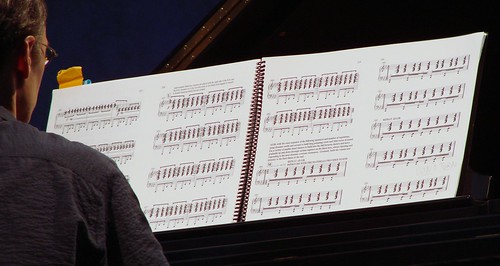
Mr. Harrison makes use of an extensively modified grand piano to realize his compositions.
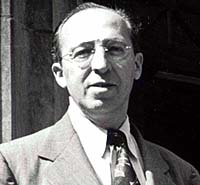
Born: 1897 Died: 1965 A tireless musical explorer and inventor, Henry Cowell was born 11 March 1897 in Menlo Park, California, where he grew up surrounded by a wide variety of Oriental musical traditions, his father's Irish folk heritage, and his mother's Midwestern folktunes. Already composing in his early teens, Cowell began formal training at age 16 with Charles Seeger at the University of California. Further studies focused primarily on world music cultures. His use of varied sound materials, experimental compositional procedures, and a rich palette colored by multiple non-European and folk influences revolutionized American music and popularized, most notably, the tone cluster as an element in compositional design.
In addition to tone clusters evident in such works as Advertisement and Tiger, Cowell experimented with the "string piano" in works like The Aeolian Harp and The Banshee where strings are strummed or plucked inside the piano. Studies of the musical cultures of Africa, Java, and North and South India enabled Cowell to stretch and redefine Western notions of melody and rhythm; mastery of the gamelan and the theory of gamelan composition led to further explorations with exotic instruments and percussion. Later, Cowell developed the concept of indeterminancy or "elastic form" in works like the Mosaic Quartet (where performers determine the order and alternation of movements).
The Piano Variations of AmericancomposerAaron Copland were written for piano solo from January to October 1930. The approximate performance time is 11 minutes.
The Piano Variations were a product of Copland's second-style period, also called the abstract period, which comprised only instrumental (non-vocal) compositions. During this time, the composer moved away from the jazzy idioms he experimented with in the 1920s and started working more in the direction of absolute music. The influence of composition pedagogue Nadia Boulanger, with whom Copland studied in Paris at the Fontainebleau School of Music for Americans, is prevalent in the formal style, logic, patterns, and attention to detail in the Piano Variations and other works in this period.
Copland stated that he worked on the variations individually without an agenda for fitting them together or sequencing them, which seems to contradict the piece's highly ordered construction and seemingly inevitable development. Copland acknowledged this contradiction but maintained that, in fact, "One fine day when the time was right, the order of the variations fell into place." Copland had ambitious plans for this "serious piano piece" — the first of three including the Piano Variations (1930), the Piano Sonata(1939-41), and the Piano Fantasy (1957); he worked painstakingly and thought at epic proportions, saying he "should like to call them like Bach did the Goldberg Variations — but thus far haven't been able to think up a good one."
Unlike a traditional theme and variations, Copland's Piano Variations are not episodic. They are continuously played through, in an undisrupted development of the four-note "row" in the theme from which Copland builds the rest of the piece. All of the content can be traced back to this or transpositions of this four-note motif, suggesting the serialist techniques of Schoenberg. The concision, rigor, and lack of ornamentation have been compared to that of the style of Anton Webern (as in his Variations for piano). The dissonances (ubiquitous minor seconds, major sevenths and ninths) are precisely chosen for their degree of "shock value." While working on the Piano Variations, Copland cultivated a tautness and clarity of form and texture that became a precursor to the style of his other works.
Copland does not actually follow the precepts of the Second Viennese School exactly, although he considers them. Aside from the fact that the four-note "row" is eight tones short of being "12-tone," Copland frequently uses repetition in a declamatory style, as well as modifies and inserts new ideas into his motifs. This is another, smaller-scale form of "variation" that pervades the whole piece. This additional degree of freedom for the composer's imagination permits a gradual metamorphosis of the theme, and in a short period of time he explores many different moods, textures, tonal centers, harmonies, tempi, and rhythms, with a powerful cumulative effect. Copland describes the result as manifesting a "very dry and bare grandiosity."
Copland also experimented with the potential of the physical instrument, as he did with microtones on the stringed instruments in Vitebsk. In the Piano Variations, some notes are held down silently while pitches selected from their overtone series are struck, which produces an effect of ringing resonances without hammering the tones directly.
Another prominent characteristic is the piece's rhythmic irregularity. The meters change constantly within an essentially 4/4 framework.
Morton Feldman's For Samuel Beckett The last large work composed by Morton Feldman before his death in 1987, For Samuel Beckett comes from a ten-year relationship with the writer, and was partly inspired by his work in setting Beckett's Words and Music in 1986.
Like many Feldman pieces, For Samuel Beckett is a lengthy exploration in sonic textures. (As Paul Cook calls it, an "eerie, meditative study in slow, dissonant pulses and atonal moods.") Since the many liner notes below go into great detail explaining the structure and compositional theory behind the piece, I will confine my remarks to a simple description -- which is fairly easy, as Feldman's work often seems best described, rather than explained. Indeed, my description is quite similar to that of Wilson's liner notes, which I read only after writing my own impressions. (I am completely aware that I am about to use visual metaphors to describe an aural experience; if this troubles you, please redirect your browser to Gramophone.com and look up something nice by that Brahms fellow.)
Imagine if you will being suddenly immersed in a vast space that extends around you in all dimensions. Above and below you are great, drifting blocks of color and texture -- dark reds, burnt yellows, occasional swatches of vibrant blue. They drift, slowly, ominously, shimmering as they pass over each other, sometimes blurry, sometimes snapping clearly into focus. Once in a while wavering forms seem to percolate up from the depths and vanish through the obscured ceiling, and somewhere in the distance it sounds like a child is playing a piano. Occasionally the blocks seem to line up, and just for a second you can see through the patterns into a vast, silent space beyond --- but only for a second. Or, at other times, they seem too clustered, too muddled, and you can almost hear the rasp of their edges as they slide off each other. There is also something vaguely sinister about them; perhaps their edges are to jagged, and they seem to loom a bit too much. In fact, it seems to be a bit claustrophobic in here, and the fact that you were just dropped there all of a sudden doesn't help -- has this been going on forever? Will it continue to go on forever? And when will you emerge? But after awhile you begin to feel less confined; in fact, there is something almost peaceful about the drifting blocks, like God gave Mark Rothko permission to design tectonic plates. After a while the patterns seem to become more pleasing; once you stopped trying to look for them, they started to emerge more readily. Oh, sure, this isn't a place where you'd want to settle down, set up shop and raise some kids; but its really not that sinister, is it? The blocks haven't actually hurt you, have they...? And just around the time you are starting to grow used to them, if not actually fond of them, they dissolve, and you are left with a silence like a thundering roar.
The Americancomposer John Cage broke new creative ground with his compositions in chance music and his works for prepared piano, in which the piano is tuned to sound, in many instances, very unlike a piano. In many of these works Cage directs the pianist to pluck the strings of the piano rather than play on the keyboard. But arguably Cage’s most famous work is the “chance” piece 4′33″ (Four Minutes and Thirty-Three Seconds), the “score” to which contains not a single note of music. Performances of the piece were intended to create a space for spontaneous “improvisation” and call to mind the unforeseen elements of the ”music” - audience members coughing (or laughing in bemusement), the shuffling of paper programs, noise of traffic on the street outside the concert hall, etc.
Irving Penn’s photograph shows Cage reaching into a grand piano as though playing one of his own non-traditional scores. But on closer inspection the image also suggests an element of controlled precision at work in this composer whose fascination with the spontaneous forced us to reconsider our definition of music. Here he moves into the bowels of the instrument in the same way a surgeon might enter a patient, with care and calculation, delicately reaching fingers for just theright string, plucking with seemingly just the right amount of spring. Penn’s image leaves us wondering what happened right after the shutter clicked. We’ll never know. That moment was lost to time and chance, probably the way Cage would have wanted it to be.
Stephen Scott (b. Corvallis, Oregon, 1944) is an Americancomposer best known for his development of the bowed piano (borrowed from C. Curtis-Smith, who invented the technique in 1972), which involves a grand piano being played by an ensemble of ten musicians who utilize lengths of horsehair, nylon filament, and other utensils to bow the strings of the piano, creating an orchestra-like sound. Scott founded the Bowed Piano Ensemble in 1977, for which he composes.
I also recommended Scott's Tears of Niobe on New Albion Records. Listen to the audio stream here.
This is not goodbye
-
When I started The Rambler back in 2003, blogs were a relatively new
phenomenon. They weren’t yet commercialised, they weren’t homogenised, they
had a Wild...
Contemporary classical music guide round-up
-
Choosing just 50 composers to tell the story of the contemporary classical
music scene has been a rich and rewarding experience, but I'm only too
aware of ...
If You’re Happy and You Know It
-
The next time I’m annoyed with the world, I’m going to try and remember to
stop what I’m doing and watch this video. And if I’m still annoyed, I’m
going to...



![Reblog this post [with Zemanta]](https://lh3.googleusercontent.com/blogger_img_proxy/AEn0k_uTFZYhMfaUtednLTiPj2zH1SZxW3GaKVQA7MSpTrffOHpym6tXTbXeU2NUxR2FNt8YdcLjEtLQWaK_EO-0b1c8RxjzF6qOvoao7OQ5Ul5dznYRyqFKcy_lKF8Wpu9nQJtYInn6SpDIThiQghHagaPO=s0-d)
![Reblog this post [with Zemanta]](https://lh3.googleusercontent.com/blogger_img_proxy/AEn0k_ti4WaHDPVVNslP2GWgviJJroo_is7aeKstZweDgpfpfKryiunuKC2o31Rgtnbphjkrb3y2UsbX_LFLXAurucaQlgxMpF7aPxoqVqmswfolhjx1ppw7ZybsI9PH8XfDytV0fZCQExaIFOVUgJ19agaD=s0-d)

![Reblog this post [with Zemanta]](https://lh3.googleusercontent.com/blogger_img_proxy/AEn0k_tHzh_HdmmM8RwKWQ_PHvdt1uHPl9KfRWeazl-s5-TRtLt16ey_VT32nXIhwAD-OdgKNMGpkcTcaS6luZ52pZp_0gzsLtHMoQDIiS_1Ef0sFaRCZfIbGNtRPl9drIaN8Oq3Y1dzyKQnmPRNJlvyJ0s=s0-d)


![Reblog this post [with Zemanta]](https://lh3.googleusercontent.com/blogger_img_proxy/AEn0k_uL6Weo9Y4_0AIsWiG8OiXJWURuFBFG4mUFkXHoWVBzb12VL6aJ8q5d56JmiNFAeRuiUqZVhpDn_hgprLpBjp-Wpg9kCDbHlvCYNUeCtnbnDZ_ApO4NrZ3QpSTzj1oyoI-d37vzEBINe-EZqTt0OsHC=s0-d)

![Reblog this post [with Zemanta]](https://lh3.googleusercontent.com/blogger_img_proxy/AEn0k_vrcZCcctelS-jIdhvrzfD5gTvOPlmHB3JbWWoApbZ7oEtQ8tfvu4bVInmIu1xDnXtapCqj5vxf-6XXqcBIL6RfUvdXRC3iUiPJgiIjg-Q43ZEDuTSCST5Shhh0Xz79ZzS3ZIf-K07qvcW1Vac2QkhO=s0-d)

 Posts
Posts


