I am nowhere man. If you are here you are indeed nowhere. The music in this collection has nothing in common, other than the fact it comes right out of nowhere.
Epitaph is a composition by jazzmusicianCharles Mingus. It is over 4000 measures long, takes more than two hours to perform, and was only completely discovered during the cataloguing process after his death. With the help of a grant from the Ford Foundation, the score and instrumental parts were copied, and the piece itself was premiered by a 30-piece orchestra, conducted by Gunther Schuller. This concert was produced by Mingus' widow, Sue, at Alice Tully Hall on June 3, 1989, ten years after his death, and again at several concerts in 2007.
The New Yorker wrote that Epitaph represents the first advance in jazz composition since Duke Ellington's Black, Brown, and Beige which was written in 1943. The New York Times said it ranked with the "most memorable jazz events of the decade". Convinced that it would never be performed in his lifetime, Mingus called his work Epitaph declaring that he wrote it "for my tombstone." Conductor Gunther Schuller said that Epitaph is "among the most important, prophetic, creative statement in the history of jazz.”
There was one ill-fated attempt to record some of this during Mingus's lifetime; a Town Hall concert on October 12, 1962. The title of the original album is Town Hall Concert and has two tracks marked "Epitaph Pt. I" and "Epitaph Pt. II", and other tracks including "Clark in the Dark", for trumpeter Clark Terry who played in the band. However, the endeavor never yielded a coherent whole like that achieved posthumously.
Dreimal sieben Gedichte aus Albert Girauds 'Pierrot lunaire', ("three times seven poems from Albert Giraud's 'Pierrot lunaire'"), commonly known as Pierrot Lunaire ("Moonstruck Pierrot" or "Pierrot in the moonlight"), Op. 21, is a melodrama by Arnold Schoenberg. It is a setting of twenty-one selected poems from Otto Erich Hartleben's German translation of Albert Giraud's cycle of French poems of the same name. The première of the work, which is between 35 and 40 minutes in length, was at the Berlin Choralion-Saal on October 16, 1912, with Albertine Zehme as the vocalist.
The narrator (voice-type unspecified in the score, but traditionally performed by a soprano) delivers the poems in the Sprechstimme style, which complements the mood of the poems aurally. Schoenberg had previously used this combination of spoken text with instrumental accompaniment, called "melodrama", in the summer-wind narrative of the Gurre-Lieder, and it was a genre much in vogue at the end of the nineteenth century. The work is atonal, but does not use the twelve-tone technique that Schoenberg would devise eight years later.
The Sorcerer, a 1977 movie by William Friedkin, provided the opportunity for German electronic music pioneer Edgar Froese to compose his first movie score. His band Tangerine Dream had been in existence for a decade and had begun to attract some critical attention as an electronic live performance group.
Although The Sorcerer as a movie was not a commercial success, it is quite compelling and is worth a watch if you happen to run across it (it's not easy to find).
Shire began scoring for television in the 1960s and made the leap to scoring feature films in the early 1970s. He was married to actress Talia Shire, for whose brother Francis Ford Coppola he scored The Conversation, perhaps his best known score, in 1974. Additional screen credits include Two People, All the President's Men, The Hindenburg, Farewell My Lovely, The Taking of Pelham One-Two-Three, 2010, Return to Oz, and Zodiac. He composed original music for Saturday Night Fever (for which he received two Grammy Award nominations), and also worked on several disco adaptations including "Night on Disco Mountain." He won the Academy Award for Best Song for his and Norman Gimble's theme song for Norma Rae, "It Goes Like It Goes". He was also nominated the same year in the same category for "The Promise (I'll Never Say Goodbye)" from the motion picture The Promise, with lyrics by Marilyn and Alan Bergman. In 1981 his song "With You I'm Born Again," recorded by Billy Preston and Syreeta, was a top five international hit and stayed on the pop charts for 26 weeks.
The Conversation featured an austere score for piano. On some cues Shire took the taped sounds of the piano and distorted them in different ways to create alternative sonic textures to round out the score. The music is intended to capture the isolation and paranoia of protagonist Harry Caul (Gene Hackman). The score was released on CD by Intrada Records.
For The Taking of Pelham One Two Three, Shire used serial techniques and a funky multicultural rhythm section for the main theme. It is intended to evoke the bustle and diversity of New York City, and is an unofficial theme for the 6 subway line (the local Lexington Avenue Line that is depicted in the film). The soundtrack album was the first ever CD release by Film Score Monthly. The end titles contain a more expansive arrangement of the theme. Shire received two Grammy nominations for his work on the film.
Born: 1897 Died: 1965 A tireless musical explorer and inventor, Henry Cowell was born 11 March 1897 in Menlo Park, California, where he grew up surrounded by a wide variety of Oriental musical traditions, his father's Irish folk heritage, and his mother's Midwestern folktunes. Already composing in his early teens, Cowell began formal training at age 16 with Charles Seeger at the University of California. Further studies focused primarily on world music cultures. His use of varied sound materials, experimental compositional procedures, and a rich palette colored by multiple non-European and folk influences revolutionized American music and popularized, most notably, the tone cluster as an element in compositional design.
In addition to tone clusters evident in such works as Advertisement and Tiger, Cowell experimented with the "string piano" in works like The Aeolian Harp and The Banshee where strings are strummed or plucked inside the piano. Studies of the musical cultures of Africa, Java, and North and South India enabled Cowell to stretch and redefine Western notions of melody and rhythm; mastery of the gamelan and the theory of gamelan composition led to further explorations with exotic instruments and percussion. Later, Cowell developed the concept of indeterminancy or "elastic form" in works like the Mosaic Quartet (where performers determine the order and alternation of movements).
LastFM: One of the most legendary of French underground rock bands, Komintern were part of that post-May of ‘68 armada of arch iconoclasts that first established French rock of the era as an unsurpassed force for radicalism, a lineage that would include the likes of Red Noise, Fille Qui Mousse, Martin Circus, Magma, and Moving Gelatine Plates amongst others. Komintern’s particular breed of sonic malarky comes couched in a frothy effervescence and jolliness that can initially mask just how extraordinary their achievement is, at one time or another musically touching on everything from early Gong-like whimsy to chanson and from Moving Gelatine Plates-style post-Canterbury motion to Red Noise-like Dadaist piss-takery. A work of timeless genius.
The Exuberant, Controversial, and Thrilling Milton Babbitt By PETER GOODMAN
"Milton Babbitt, the crabbiest, most ascetic atonalist in America." — Norman Lebrecht, Critic
"My view of his music is that it is exuberant, full of playfulness, and at same time it is unbelievably rigorous." — Peter Lieberson, Composer
"Very few conductors venture into Babbitt territory—either they are afraid of the music or don't like it and revile it, and they know that most musicians in the orchestra will either not understand it or hate it, or both. For myself, I have to say every time I have conducted Babbitt has been a great thrill, to get inside that music with those marvelous sounds and textures, and the incredible variety within each piece." — Gunther Schuller, Conductor/Composer
There you have it, ladies and gentlemen: Milton Babbitt, crabby, exuberant, reviled, playful, rigorous, thrilling. The composer who has been among the most controversial yet influential figures in American concert music of the past 60 years. The theorist whose vision about the direction that music should take dominated the academy for decades. The teacher who has guided generations of young composers both at The Juilliard School and in the Ivy League. The man who, as he celebrates his 90th year, continues to lead a full life as a composer and pedagogue, and who glows at the thought that James Levine, one of his most powerful champions, is now in command at the Boston Symphony.
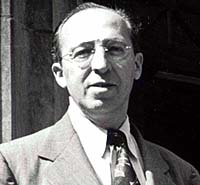
In person, Milton Babbitt is a small, compact figure whose pursed lips and twinkling eyes behind thick black frames seem always on the edge of a smile. His conversation is quick, his thought fluid, able to dart from one subject to another at the drop of an implication. Just like his music, some might say. Joel Sachs, a Juillliard colleague for many years, makes the comparison directly.
Sachs describes an occasion when he played one of Babbitt's piano compositions at the Dartington Summer Festival in England. "Milton was there," Sachs recalled, "always at the lunch and dinner tables, always gabby, very friendly, very funny." At the recital, Sachs told the audience that one way to "get" Babbitt's music is to think of it as "being like a conversation" with the composer. After the concert, an elderly woman came up to Sachs and said, "Thinking of the conversations with him made all the difference."
"If performers can present his music as conversation that goes by very quickly and very naturally," Sachs said, "that can make a difference."
Gabby playfulness is not the image most concertgoers have of Milton Babbitt, if they have any image at all. Those with some knowledge of music history might recall the February 1958 essay from High Fidelity magazine with the unfortunate—and inaccurate—headline, "Who Cares If You Listen?" That was not Babbitt's choice; he says he would have preferred "The Composer as Specialist."
But the argument of the essay, written in a style that is simultaneously precise and convoluted, was that composers of "serious," "advanced" music should retreat into the cloisters of the academic world. Only there, Babbitt contended, among colleagues in such disciplines as physics, mathematics, and analytic philosophy, could they pursue the creation of work that very few in the outside world would be expected to understand.
Born in Jackson, Miss., in 1916, as a child Babbitt was both musical and mathematical. The interest in numbers came from his father, who was an actuary. The interest in music was eclectic. He studied piano, clarinet, and saxophone, and by the time he graduated from high school he was already playing jazz and popular songs.
When he entered college, Babbitt's first impulse was to study math at the University of Pennsylvania, but he quickly switched to music, studying with Marion Bauer and Philip James at N.Y.U., and later studied privately with Roger Sessions. He did graduate work at Princeton, and continued to divide his time between music and mathematics. Although Babbitt's intellectual bent was toward the mathematical side of music (in 1946 he wrote a paper on "The Function of Set Structure in the Twelve-Tone System"), he didn't give up on pops, with some film scores and an unsuccessful Broadway musical.
Once he settled in, however, the music Babbitt wrote was meant to be as carefully defined as the most complex experiment of physics or the most elegant mathematical solutions. In his musical universe, expanding on the 12-tone system developed by Arnold Schoenberg, every note of every composition needed to be prescribed not just by pitch, but by other sonic variables including register, dynamics, duration, and timbre.
This was music that seemed, in its apparent unpredictability, extreme and unexpected leaps in pitch and dynamics, to be almost incomprehensible to the general listener, a fact which Babbitt not only recognized but advocated. "The time has passed," he wrote, "when the normally well-educated man without special preparation could understand the most advanced work in, for example, mathematics, philosophy, and physics. Advanced music, to the extent that it reflects the knowledge and originality of the informed composer, scarcely can be expected to appear more intelligible than these arts and sciences to the person whose musical education usually has been even less extensive than his background in other fields."
Nearly everything that he has written presents such difficulties to listener and performer. From Philomel, an extraordinary work for soprano, recorded soprano, and tape premiered in 1964 using computer-synthesized sound, to Concerti for Orchestra, commissioned and premiered by the Boston Symphony one year ago, Babbitt's music demands extremely concentrated listening, and more than once.
Not only has Babbitt been the exponent of a radical method of writing and analyzing music, he has also been a pioneer in methods of making its sounds. During the late 1950s and '60s he worked extensively with the RCA Mark II Synthesizer at the Columbia-Princeton Electronic Music Center. Not a performance instrument such as the synthesizers used by popular bands today, it was nevertheless the first electronic music synthesizer.
Philomel, written for soprano Bethany Beardslee, is the most famous of his compositions using the synthesizer. Set to a text by the poet John Hollander, it uses the soprano's live voice, her taped voice, and sounds created by the synthesizer to create an alien, disorienting, intense sonic environment.
And, although Babbitt turned away from electronics after the Mark II was vandalized in the 1970s, his music continues to seem disorienting and intense. Yet, despite the complexity of the method by which he writes, and the dense language used to explain it, Babbitt's music is surprisingly transparent, even spare. It is often tender and gentle, and filled with important silences, rather than being harsh, abrupt, and thick.
In his Boston Globe review of Concerti for Orchestra, critic Richard Dyer wrote: "Babbitt's music thrives on the borderline between extreme intellection and extreme emotion. The new piece has all the brainpower of its predecessors within it, but without the bristling density of event. It is music of remarkable transparency of texture, clarity of detail, and spaciousness."
Peter Lieberson compares Babbitt's music to his personality in a way similar to Sachs's assessment: "His mind works very fast. You can hear recalls, subtle references to what happened earlier. It is so subtle that, if you listen to it once it will bypass you. If you listen over and over, while looking at the score, you realize that that kind of association is happening constantly in the music. There are so many of them that it is sometimes difficult to absorb in one listening."
Whatever the theory and impact of his own music, as a teacher Babbitt does not demand stylistic loyalty. On the Juilliard composition faculty since 1971 and at Princeton University's music department from 1938 to 1984 (when he retired and became professor of music, emeritus), he has worked with generations of students who have a remarkable variety of styles. Besides composers such as Lieberson and fellow Juilliard professor Jonathan Dawe, Babbitt's pupils have included Stephen Sondheim, whose music is known for a different sort of complexity. Clearly, he did not impress his own views on their work.
"He never tried to impose himself," Dawe said. "He never tried to spin things in a direction he would think was his esthetic or style. But he had a very strong, intrinsic awareness of your music. In a lesson situation, he does seem to get into a student's music, to get to know it. He was very helpful."
Lieberson had the same experience. "There was no attempt on his part to guide me in a particular direction," he said. "If he was interested in what I was doing, he made himself completely available," even if Babbitt's ideas weren't immediately comprehended.
Babbitt's late wife of 66 years, Sylvia, once told Lieberson, "Milton doesn't want people's music to sound like him, to become like him as a composer."
Viewed from the opposite direction, Babbitt's music is unique. "There are no composers, really, that you can say stylistically sound like Milton Babbitt," Lieberson said. "Nobody sounds like Milton Babbitt."
Peter Goodman recently retired from a career as a music critic, reporter, and editor at Newsday. He is the author of Morton Gould: American Salute (Amadeus, 2000).
Composed in 1957 for the Brandeis University Arts Festival, which in that year was a jazz festival, All Set is scored for a small jazz ensemble consisting of alto and tenor sax, trumpet and trombone, bass, vibes, piano and drums. While written in the jazz idiom, the work utilizes an all-combinatorial 12-tone row as its material. Characteristic of the "Chicago style", solo and ensemble juxtapositions recall "certain characteristics of group improvisation (Barkin), while the sections correspond to serial technique. While the available literature concerning the work is quite limited, Milton Babbitt has this to say on his work:
"Whether All Set is really jazz I leave to the judgment of those who are concerned to determine what things reallyare, and if such probably superficial aspects of the works as its very instrumentation, its use of the 'rhythm section,' the instrumentally delineated sections which may appear analogous to successive instrumental 'choruses,' and even specific thematic or motivic materials, may justify that aspect of the title which suggests the spirit of a 'jazz instrumental,' then the surface and the deeper structure of the pitch, temporal, and other dimensions of the work surely reflect those senses of the title, the letter of which brings the work closer to other of my compositions, which really are not jazz." Although remaining faithful to his 12-tone system of composition, Babbitt's effective use of jazz inflection proves that 12-tone music not only can be extremely flexible, but also can indeed be fun! Salzman (1988) remarks that while Babbitt remains "... faithful to a vision of total rationality and control..." the work itself relates "... to [the] character of the live performance, situation and virtuosity of the performers." In this sense, the virtuosity reflects the extremely complex rhythms of the instrumental parts, often polyphonic, which are sounded against a more regular pulse of the drums. Not only are these instrumental parts rhythmically complex, but the melodic lines are extremely angular, requiring a great deal of concentration and control on the part of the performers.
The work is experimental, in that it is the first one in which Babbitt used the idea of ‘time point sets.' Glen Watkins (1988) asserts that Babbitt was "... dissatisfied with the incompatibilities of serial procedures used for pitch and rhythm..." which resulted in Babbitt's creation of a system that could be applied in a more flexible way. Watkins: "Here the obvious need for a clear and audible metric organization is acute if such an organization is to have any meaning for the listener." This statement obviously refers to Babbitt's famous and much misunderstood article "Who Cares if You Listen?" in which Babbitt places the responsibility of understanding and recognizing serial procedures upon performers and listeners.
The problem, as approached encountered by European serialists such as Pierre Boulez and Karlheinz Stockhausen, was a matter of whether the serial technique was perceptible when applied to a rhythmic system. Boulez and Stockhausen, among others, attempted to solve this by applying serial technique to duration. However, when Babbitt understood that the perception of duration was a subjective phenomenon, he successfully solved the issue by applying serial technique to a system of ‘attack points’ corresponding to the series. Simply put, the human brain understands the beginning of an event, but has trouble perceiving ‘how long’ the event has lasted without an external reference of measurement. Therefore, a variety of durational values could be assigned to notes in the series, creating a fluid and flexible system while at the same time adhering to a ‘strict’ rhythmic system that is perceptible to the listener.
Watkins describes the concept of time point sets as one in which "... various note-values are identified by their position at the point of attack within the bar". However, Charles Wuorinen is much more specific in elaborating on Babbitt's concept. Wuornin (1979) defines a time point as "... simply a location in the flow of time." In describing the time point system, he informs us that the concept is based upon two principles: "1) The relationships of the pitch system are transferred in their totality to the sphere of time relations; 2) This transfer is accomplished through the linkage of one simple equivalence - that of time intervalcorresponding to pitch interval." In this usage both time and pitch continuums are applied to modules which correspond to respective intervals, thus arriving at a flexible system in which time and pitch intervals can be varied from work to work. Wuorinen: "... twelve interval divisions of the time modules will therefore make up twelve time-point classes..." In this system, the time points may be identified by locating their points of attack, which have nothing to do with individual event duration. While in All Set Babbitt applies this use to the traditional 12-note series, this system is flexible in that it can be used in series containing other than 12 notes. Additional flexibility can be obtained by varying the lengths of time interval divisions.
While Babbitt obtains contrast by applying operations to different groups of instruments, the overall sonority and way in which he applies the time-point set theory in All Set creates an extremely unified composition.
The Piano Variations of AmericancomposerAaron Copland were written for piano solo from January to October 1930. The approximate performance time is 11 minutes.
The Piano Variations were a product of Copland's second-style period, also called the abstract period, which comprised only instrumental (non-vocal) compositions. During this time, the composer moved away from the jazzy idioms he experimented with in the 1920s and started working more in the direction of absolute music. The influence of composition pedagogue Nadia Boulanger, with whom Copland studied in Paris at the Fontainebleau School of Music for Americans, is prevalent in the formal style, logic, patterns, and attention to detail in the Piano Variations and other works in this period.
Copland stated that he worked on the variations individually without an agenda for fitting them together or sequencing them, which seems to contradict the piece's highly ordered construction and seemingly inevitable development. Copland acknowledged this contradiction but maintained that, in fact, "One fine day when the time was right, the order of the variations fell into place." Copland had ambitious plans for this "serious piano piece" — the first of three including the Piano Variations (1930), the Piano Sonata(1939-41), and the Piano Fantasy (1957); he worked painstakingly and thought at epic proportions, saying he "should like to call them like Bach did the Goldberg Variations — but thus far haven't been able to think up a good one."
Unlike a traditional theme and variations, Copland's Piano Variations are not episodic. They are continuously played through, in an undisrupted development of the four-note "row" in the theme from which Copland builds the rest of the piece. All of the content can be traced back to this or transpositions of this four-note motif, suggesting the serialist techniques of Schoenberg. The concision, rigor, and lack of ornamentation have been compared to that of the style of Anton Webern (as in his Variations for piano). The dissonances (ubiquitous minor seconds, major sevenths and ninths) are precisely chosen for their degree of "shock value." While working on the Piano Variations, Copland cultivated a tautness and clarity of form and texture that became a precursor to the style of his other works.
Copland does not actually follow the precepts of the Second Viennese School exactly, although he considers them. Aside from the fact that the four-note "row" is eight tones short of being "12-tone," Copland frequently uses repetition in a declamatory style, as well as modifies and inserts new ideas into his motifs. This is another, smaller-scale form of "variation" that pervades the whole piece. This additional degree of freedom for the composer's imagination permits a gradual metamorphosis of the theme, and in a short period of time he explores many different moods, textures, tonal centers, harmonies, tempi, and rhythms, with a powerful cumulative effect. Copland describes the result as manifesting a "very dry and bare grandiosity."
Copland also experimented with the potential of the physical instrument, as he did with microtones on the stringed instruments in Vitebsk. In the Piano Variations, some notes are held down silently while pitches selected from their overtone series are struck, which produces an effect of ringing resonances without hammering the tones directly.
Another prominent characteristic is the piece's rhythmic irregularity. The meters change constantly within an essentially 4/4 framework.
This is not goodbye
-
When I started The Rambler back in 2003, blogs were a relatively new
phenomenon. They weren’t yet commercialised, they weren’t homogenised, they
had a Wild...
Contemporary classical music guide round-up
-
Choosing just 50 composers to tell the story of the contemporary classical
music scene has been a rich and rewarding experience, but I'm only too
aware of ...
If You’re Happy and You Know It
-
The next time I’m annoyed with the world, I’m going to try and remember to
stop what I’m doing and watch this video. And if I’m still annoyed, I’m
going to...

![Reblog this post [with Zemanta]](https://lh3.googleusercontent.com/blogger_img_proxy/AEn0k_voEWTH2IjM7jjHQDIioD0PK8IPLL3QmfPboyQEDgrBa7Zc6d33AvGGmg5hQeYKreAvjNMzSIHTKiegPGbsontiZebaKkGHTsWhnRdaiCl1S-l9-4iqImUlnPWkKFajyWfsUbUp90EPPK99VT0_aPZX=s0-d)

![Reblog this post [with Zemanta]](https://lh3.googleusercontent.com/blogger_img_proxy/AEn0k_teFrWT6_dS9XNTZd55MFf1Orzs1s_lARfusF_OOagvZi5tx3gGA_Z2Jw3NYPpengqomBZT8jsUR4-xZdsIb5-OV7LODVmnkxeIfbDVCFv13HF5AT8o08qCklnkcROvE3y4Oyx5jShhM-eTtS2U1CY=s0-d)

![Reblog this post [with Zemanta]](https://lh3.googleusercontent.com/blogger_img_proxy/AEn0k_u8iMifk77bOSTYe2R4cAgn-B-8yh8XC-sWYMisrsk0PTEFcJb_9RgkDhwkmPgGMnnEn5mFbW5aVfLA5cf9fLJFdPLNeYFje3aLfdNwb-tT69r6sIqtwZNtBJCom89IbrfJcESxE-7Eorvzwm4ROGk=s0-d)

![Reblog this post [with Zemanta]](https://lh3.googleusercontent.com/blogger_img_proxy/AEn0k_uIkB06XyZRPprSp7jFDMcAe048Lbo6am8UixSY6id09al_KGOeyhlolM3DDUcbF5qxHOptwgiHwuITF5AHanzo5ScU64WakC_x3tKOOMSIDBDvpzAXGXd72rmKn51Tw5NbrU-4ykCAqfoZv6DfRio=s0-d)


![Reblog this post [with Zemanta]](https://lh3.googleusercontent.com/blogger_img_proxy/AEn0k_vYKaDuhfk_TZA5oH0HEEHPXGAjxlq2cwV1M-bGxTXqyfSYIOngVzW4x-6yP3E8K3xy3eHCnMHN3A5unMunLx4ql1nvNE88Qqc8yvljJ-XL-WfRx3MQRtGYB0Zy2imvGeP-IWhwVK_IkUfbyPNxAfm6=s0-d)

![Reblog this post [with Zemanta]](https://lh3.googleusercontent.com/blogger_img_proxy/AEn0k_vdKgV01wQ_vLbfT7jwIp5eXimdl8XPU7JUdcg4QQPWaOWlBiacJNOqm9DB3udPapkHWVu6p4E_nRbdb6XzqENEdtKADgSoiUyaIZceZovhoKj4VsAx_w9LVA8dHp7zNwGbzr4sB_0fZBhJHdCCv_xw=s0-d)

![Reblog this post [with Zemanta]](https://lh3.googleusercontent.com/blogger_img_proxy/AEn0k_t6BrdBBGWI4QScNu1HFZWnF4HA3kf_749F7ND6pcTn6MMKNGzdVkRcCgv7dSuELtQivb90Z1wD1m81jIM2KqK_taClfnayN1AasXIBqj6PUWPiGLZ-mp2bEAleYKt0s3hyzEXM0H5yiCQMA3uEcn07=s0-d)
![Reblog this post [with Zemanta]](https://lh3.googleusercontent.com/blogger_img_proxy/AEn0k_sqauvEd7LYeUdRQvaFqbY4sA3N-RmPcJsXO9ofgmf3P0bMvdzHqQuTWIIKWOKAA3dQ9uZgx1ZnyQDyBhgkPb31G-iewWfBc0MHCKQ_J0UBLmjv7Nw3BasZLfJ17x02zHNRLikTy9NWeCx58jv_cq1l=s0-d)

 Posts
Posts


